
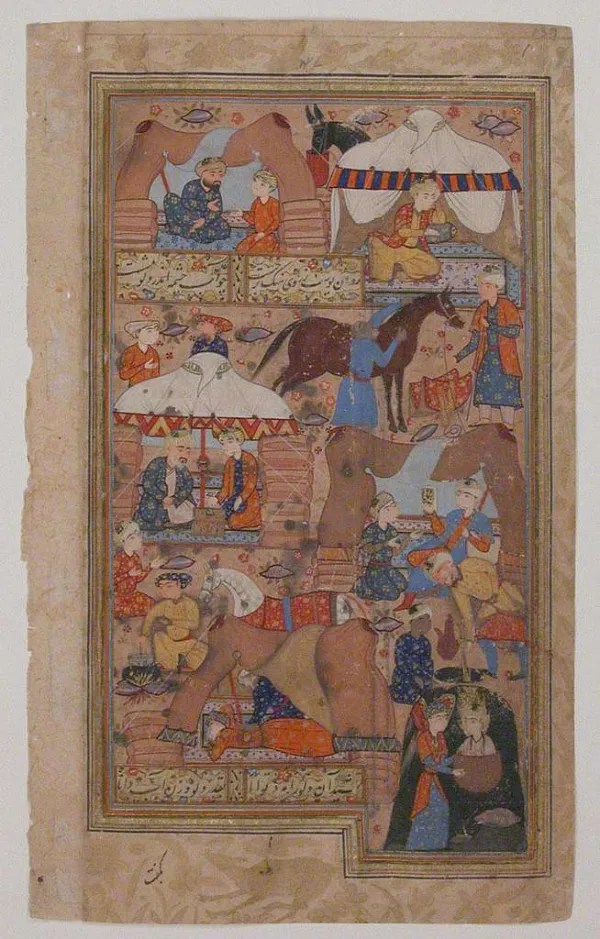
Yusuf is drawn up from the well Public domain photo of a golden object, Iran, free to use, no copyright restrictions image - Picryl description
The 12-day war between the United States, Israel, and Iran in 2025, followed by renewed conflict on February 28, 2026, revealed not merely a military confrontation, but a fundamental misreading of how political power survives. The strategy pursued by Washington and Tel Aviv appeared to rest on a familiar assumption of modern interventionism: that authoritarian states are internally hollow, and that sufficient military pressure combined with popular discontent whether staged or organic can trigger rapid political collapse from within.
According to reporting by Israeli newspaper Ynet, the Mossad established an “influence network” intended to stimulate protest movements inside Iran during the conflict. The expectation was clear. Once senior leadership had been eliminated, Kurdish forces who were already trained in Iraq would advance, mass demonstrations would erupt, state cohesion would fracture, and an alternative political order would emerge through the vacuum left behind.
But the anticipated collapse never materialized.
After forty days of coordinated military operations targeting Iran’s nuclear infrastructure, military assets, command structures, and senior leadership — operations that ultimately culminated in the killing of the Supreme Leader — the state nevertheless did not disintegrate. For many external observers, the assassination of the Supreme Leader represented the ultimate decapitation scenario: the assumption that the symbolic and organizational center of the Islamic Republic could not survive its removal. Yet even after the death of its highest authority, the state endured.
Instead of fragmentation, the war accelerated internal consolidation around the security apparatus. The crisis strengthened nationalist cohesion, reinforced the state’s siege mentality, and elevated the Islamic Revolutionary Guard Corps from a powerful parallel institution into the dominant center of political authority. The clerical establishment increasingly receded into symbolic legitimacy while the IRGC consolidated direct influence over security, economic coordination, strategic planning, and the mechanisms of state continuity.
This outcome surprised many external observers because it contradicted a widely held assumption shared across both foreign policy circles and segments of the Iranian opposition: that social dissatisfaction necessarily translates into revolutionary vulnerability. But authoritarian systems can suffer profound crises of legitimacy while retaining substantial coercive and administrative capacity. These are not the same thing.
Many Iranians oppose the Islamic Republic. Many are alienated by repression, corruption, sanctions, economic decline, and clerical rule. Yet opposition to a government does not automatically produce support for state collapse — particularly when no organized alternative exists capable of guaranteeing territorial integrity, economic continuity, administrative order, or protection from civil fragmentation. Under military attack, national survival often becomes more immediate than democratic transformation. Populations frequently distinguish between dissatisfaction with a regime and the destruction of the state itself.
This distinction proved decisive.
States do not survive solely through ideological legitimacy. They survive through institutions, bureaucracies, economic networks, patronage systems, and the organized monopolization of violence. Even weakened states possess enormous structural advantages over fragmented oppositional forces.
External pressure often intensifies these advantages rather than weakening them. Wartime conditions centralize authority, strengthen coercive institutions, and elevate actors already capable of coordinating security and resources at scale. Citizens may resent the state while simultaneously fearing the consequences of its collapse.
Modern state failure repeatedly demonstrates this pattern. In Iraq after 2003 and Libya after 2011, authoritarian regimes collapsed more quickly than the institutional structures capable of replacing them could emerge. The result was not democratic consolidation, but fragmentation, militia competition, and the redistribution of coercive power among armed actors already positioned to dominate the vacuum. Regime collapse alone does not produce democracy. It merely removes one configuration of power so another may take its place.
The failure lay not simply in military miscalculations, but in a deeper confusion between desire and power.
This is where the allegory of Yusuf and Zuleikha acquires renewed political relevance. In Persian literary tradition, the story is often read as a meditation on moral restraint and unfulfilled desire. Zuleikha, the wife of a powerful Egyptian ruler, desires Yusuf intensely, yet her position affords her no legitimate authority over him. Yusuf, though enslaved, is protected by law, reputation, and divine sanction; his body is constrained, but his fate is not hers to command. When Yusuf refuses her, the refusal is not merely ethical. It is structural. Zuleikha’s longing exceeds her capacity to possess, protect, or reproduce what she desires. Her tragedy lies not in excess passion, but in desire severed from power.
The allegory endures because it illustrates a political truth as much as a personal one: desire without institutional capacity or power cannot determine outcomes.
The opposition’s democratic aspirations may have been genuine, but aspiration alone could neither seize nor stabilize state power. What external planners anticipated was not an organized democratic transition, but an improvisational transfer of authority generated by emotional momentum and institutional breakdown. Yet revolutions do not emerge from absence alone. They require durable social forces capable of replacing the administrative, military, and economic functions of the existing state.
No such force existed.
Iran’s opposition remained fragmented across ideological, geographic, and class lines. Diaspora organizations possessed media visibility but limited institutional presence inside the country. Protest movements demonstrated enormous courage but lacked durable leadership structures, labor coordination, territorial organization, or alternative governing institutions. Social anger existed. Durable political machinery did not.
The failure of the anticipated uprising therefore demonstrated something deeper than the resilience of the Islamic Republic alone. It revealed the durability of the material structures underlying the Iranian state: coercive institutions, patronage networks, sanctions economies, and militarized forms of class power accumulated over decades. External planners appeared to mistake the Islamic Republic for a highly personalized regime whose survival depended primarily on symbolic leadership. In practice, the state proved far more institutionally entrenched than anticipated.
The war exposed the limits of a politics centered entirely on negation — the belief that removing the regime itself constitutes a political strategy. In practice, collapse without organized replacement rarely produces democracy. More often, it intensifies coercion, fragmentation, or military consolidation.
Modern states rarely collapse because populations cease to believe in them. They collapse when alternative institutions emerge that can coordinate violence, administration, and economic life more effectively than the state itself. In this sense, the war did not resolve Iran’s democratic impasse. It clarified it. The central obstacle was never merely authoritarian leadership itself, but the absence of a countervailing force capable of transforming democratic aspiration into durable political power. The crisis revealed the gap between social discontent and institutional capacity, between moral legitimacy and organized force.
Democratic desire existed. The institutions capable of stabilizing and reproducing democratic power did not. Until democratic aspirations become institutional power, it will remain vulnerable to those who already possess organized force.